
Journal of Law, Justice & Public Governance (DJG)
DJG is an open access scholarly journal published by Presses universitaires de l’Institut Universitaire des Sciences (P‑IUS). Semi‑annual journal (2 issues per year). It publishes original peer‑reviewed research, thematic issues, and may also accept scholarly monographs and edited volumes.
Submit ArticleArchives
The Rule of Law Under Strain in Haiti
Vol. 1 No. 1 (2025)
This inaugural issue of Law, Justice and Public Governance examines the contemporary fractures of the rule of law in Haiti through a unifying lens: when insecurity becomes entrenched, justice, governance, and democratic cohesion are simultaneously weakened. The articles bring together socio-legal analyses of crime, debates on judicial independence, reflections on democratic exclusion, and discussions on how Haitian positive law adapts to enduring social practices.
A first set of contributions investigates crime and insecurity by emphasizing their institutional and territorial drivers. The socio-legal study of criminality mobilizes the theory of territorial imbrication to show that violence cannot be understood as a purely local phenomenon: it is shaped by interactions across local, national, and international levels, challenging existing frameworks in international criminal law. In a complementary way, the article on resolving insecurity stresses the legal and political conditions for crisis management, placing judicial independence at the center while connecting it to broader issues of self-determination and the reform of international relations.
A second axis focuses on the legal foundations of an independent justice system through the pivotal role of the judiciary. By revisiting the normative architecture of Haiti’s judicial power, the analysis highlights weaknesses in rules governing the appointment and oversight of judges and points to an underlying dependency on the executive branch. The argument is straightforward: without a truly independent judiciary, proclaimed judicial independence remains partial and fragile.
A third axis broadens the scope to democratic governance and its contradictions. Drawing on the theory of incompatible public choices, one article analyzes the dynamics that exclude rural populations, showing how institutional structures and elite practices can undermine declared commitments to citizen participation. Democracy is thus approached as a tension-filled system, where strategic reforms are needed to transform incompatible public choices into more inclusive outcomes.
Finally, the issue foregrounds legal pluralism and the adaptation of law to social realities, through the study of plaçage. By examining the coexistence of imported law and customary practices, the article argues for moving beyond a rigid monism/dualism divide and for recognizing plaçage as a legal category in its own right—particularly in relation to family and property rights.
Taken together, the contributions deliver a coherent message: strengthening the rule of law in Haiti requires addressing insecurity at its roots, consolidating the effective independence of the judicial branch, correcting public choices that produce exclusion, and embracing a form of legal pluralism that integrates social practices without compromising fundamental legal principles.
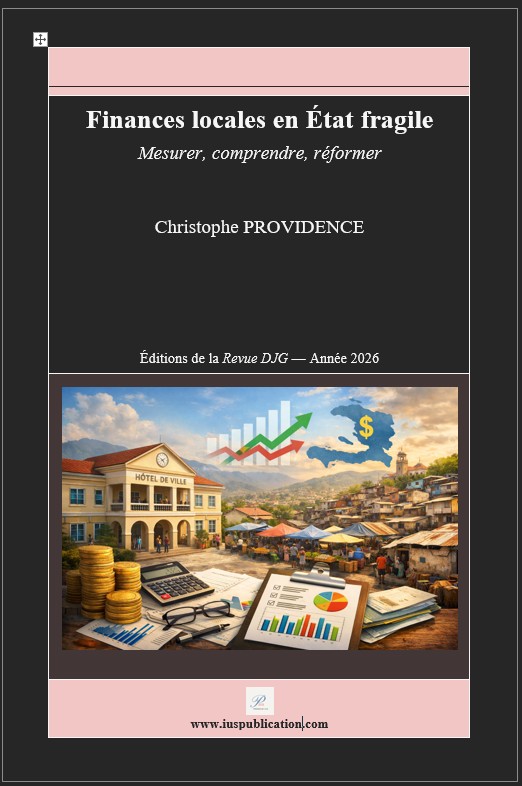
Local Finances in a Fragile State: Measuring, Understanding, Reforming (Academic Book) - Professor Christophe Providence
2026
This book offers an original analytical framework for assessing the financial health of local governments in Haiti, based on three interdependent dimensions: fiscal viability, managerial flexibility and structural vulnerability. Drawing on a comparative study of twenty municipalities, it introduces a set of nine operational indicators to evaluate local governments’ capacity for sustainability, adaptability, and resilience in fragile contexts.
Rejecting technocratic models imported from OECD countries, the approach embraces a context-sensitive methodology, resulting in a functional typology of Haitian municipalities. This typology reveals contrasting profiles — robust, intermediate, and fragile — and sheds light on locally rooted strategies of institutional adaptation. The book advocates for a comprehensive reform of local financial governance, grounded in territorial justice, differentiated contracting, and the recognition of endogenous innovation.
Aimed at scholars, policymakers, development practitioners, and local leaders, this work is both a decision-making tool and a scientific contribution to more just, contextual, and resilient governance in fragile states.
Insecurity and governance: legal and institutional responses
Vol. 2 No. 1 (2026)
This themed issue of the peer‑reviewed journal DJG addresses “Insécurité et gouvernance : réponses juridiques et institutionnelles”. We welcome doctrinal analyses, case‑law reviews, case studies and empirical research on institutions, state reform, regulation and public governance. Submissions should be explicit about sources (legal texts, decisions, datasets), methods and normative implications, including enforceability, access to justice and accountability in Haiti and comparative settings.
Submission
Image
e-ISSN: 3135-0941
p-ISSN: 3135-0933