General Introduction
DOI:
https://doi.org/10.66860/djg.v.i.37Keywords:
Financial health, Local finances, Fragile state, Haiti, Decentralization, Territorial asymmetries, Local governance, Local taxationAbstract
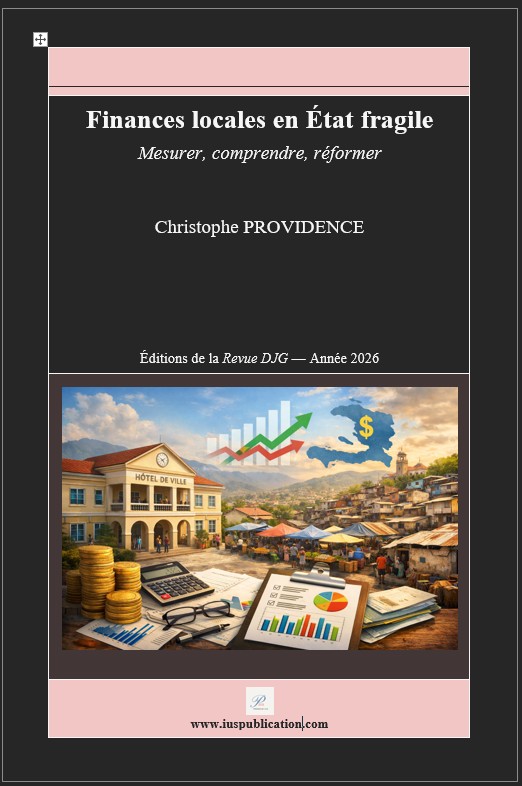
This book offers an original analytical framework for assessing the financial health of local governments in Haiti, based on three interdependent dimensions: fiscal viability, managerial flexibility and structural vulnerability. Drawing on a comparative study of twenty municipalities, it introduces a set of nine operational indicators to evaluate local governments’ capacity for sustainability, adaptability, and resilience in fragile contexts.
Rejecting technocratic models imported from OECD countries, the approach embraces a context-sensitive methodology, resulting in a functional typology of Haitian municipalities. This typology reveals contrasting profiles — robust, intermediate, and fragile — and sheds light on locally rooted strategies of institutional adaptation. The book advocates for a comprehensive reform of local financial governance, grounded in territorial justice, differentiated contracting, and the recognition of endogenous innovation.
Aimed at scholars, policymakers, development practitioners, and local leaders, this work is both a decision-making tool and a scientific contribution to more just, contextual, and resilient governance in fragile states.
References