
Journal of Civil Society, Social Movements & Education (SME)
SME is an open access scholarly journal published by Presses universitaires de l’Institut Universitaire des Sciences (P‑IUS). Semi‑annual journal (2 issues per year). It publishes original peer‑reviewed research, thematic issues, and may also accept scholarly monographs and edited volumes.
Submit ArticleArchives
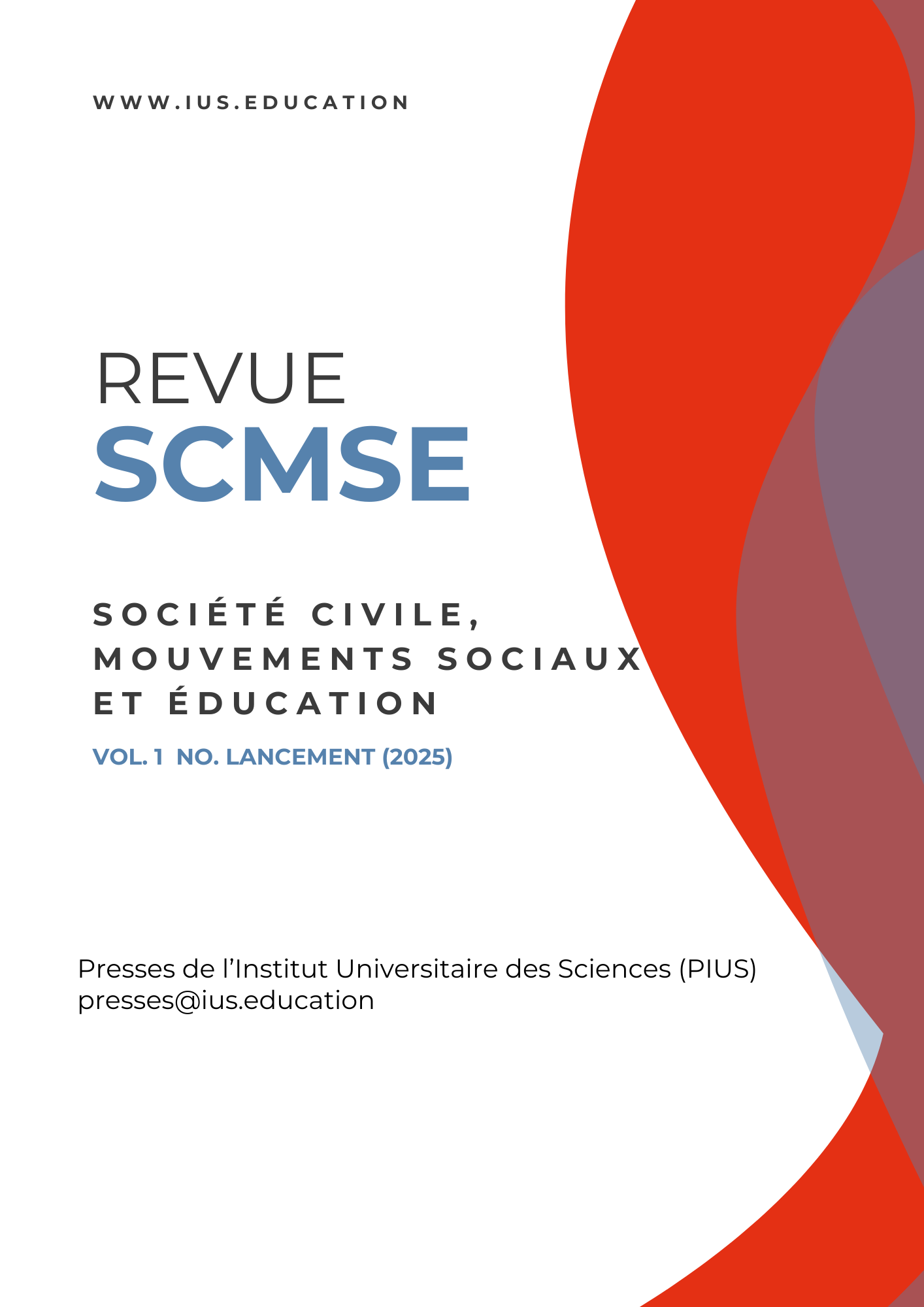
Education, Vulnerability, and Civil Society in Haiti
Vol. 1 No. 1 (2025)
This inaugural issue of Civil Society, Social Movements and Education examines how Haiti’s educational challenges are deeply intertwined with broader social vulnerabilities, institutional fragility, and the evolving role of civil society. The collected articles frame schooling not only as a site of learning, but also as a space where social conflict, inequality, protection, and public action converge.
A first set of contributions focuses on school continuity and academic achievement. The study of teacher strikes in Jacmel (2018–2023) shows how prolonged disruptions weaken learning processes and are associated with repeated patterns of failure in national examinations. Complementing this, the article on educational management for students in vulnerable situations highlights how internal school governance—staff involvement in decision-making, ongoing training, motivation, overcrowded classrooms, and inadequate compensation—shapes learning conditions and student success.
A second axis addresses child protection and rights, through an empirical investigation of children in street situations in Port-au-Prince. Field interviews point to the structural roots of the phenomenon—poverty, peripheral slums, fragile family arrangements—and reveal the limits of Haiti’s broader social protection system. The issue thus expands the education debate toward a larger question: how public policy and civil society can jointly build effective support systems for at-risk children.
A third axis explores the material and pedagogical foundations of inclusive schooling. The discussion of school infrastructure and disability—particularly in the Great South—positions accessibility, equipment, maintenance, sanitation facilities, and school furniture as core determinants of educational quality and equal opportunity. Similarly, the study on teaching philosophy in secondary schools questions the adequacy of current didactic practices in the context of competency-based education, advocating approaches that genuinely foster critical thinking.
Finally, the issue offers a sociological lens on childhood through the article on children’s games under political violence: spontaneous play becomes a mirror of conflicts, abuse, and inequality, providing empirical insight into socialization, resilience, and collective representations.
Overall, the issue advances a central message: academic success in Haiti cannot be addressed without simultaneously engaging children’s rights, school governance, infrastructure, teaching practices, and the collective capacity—State, communities, and civil society—to protect and support the most vulnerable.
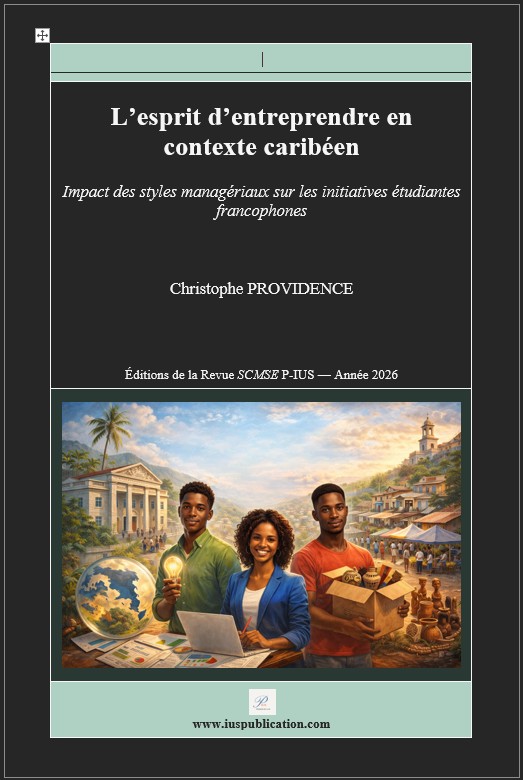
Entrepreneurial Spirit in a Caribbean Context: The Impact of Managerial Styles on Francophone Student Initiatives (Academic Book) - Professor Christophe Providence
2026
1. A new look at entrepreneurship in a French-speaking postcolonial context
This book offers a rare and committed analysis of entrepreneurship in the French-speaking Caribbean, a space too often absents from French-language research and publications. It articulates economic dynamics, colonial legacies and educational practices, going beyond the usual technical list readings.
2. A tool that can be mobilized for educational institutions, territories and professionals
This book is not satisfied with a diagnosis. It proposes a Caribbean model of educational entrepreneurship, structured, illustrated, operational, which can feed the reflections and practices of teachers, supervisors, communities, universities and incubators working in and for postcolonial territories.
3. A strategic contribution to thinking about Francophone regional cooperation in the South
By drawing scenarios of convergence between territories, by valuing situated knowledge and South-South dynamics, this book opens up an original and necessary perspective on Caribbean cooperation. It is fully in line with contemporary debates on educational sovereignty and co-constructed territorial development.
Dive into the heart of this reflection and discover how to build a more inclusive, dynamic entrepreneurial ecosystem adapted to the realities of the French-speaking Caribbean!
Youth, citizenship and social innovations
Vol. 2 No. 1 (2026)
This issue of the peer‑reviewed journal SCME explores “Jeunesse, citoyenneté et innovations sociales” at the intersection of education studies, sociology, political science and development research. We invite quantitative, qualitative and mixed‑methods papers analyzing educational change, civic participation and social innovation mechanisms. Manuscripts should articulate theory, methods and policy implications, with attention to inequalities, vulnerability and Haiti‑diaspora contexts.
Submission
Image
e-ISSN: 3135-0925
p-ISSN: 3135-0917