
Journal of Leadership, Planning, Tourism & Sustainable Development (LATDD)
LATDD is an open access scholarly journal published by Presses universitaires de l’Institut Universitaire des Sciences (P‑IUS). Semi‑annual journal (2 issues per year). It publishes original peer‑reviewed research, thematic issues, and may also accept scholarly monographs and edited volumes.
Submit ArticleArchives
Haiti: Territories and Sustainability
Vol. 1 No. 1 (2025)
This inaugural issue of Leadership, Planning, Tourism and Sustainable Development examines the practical foundations of more balanced territorial development in Haiti. Its core premise is straightforward: territories do not transform through planning alone, but through the quality of local institutions, the ability to finance public action, and the strength of linkages among economic, social, and political actors.
A first set of articles addresses the financial backbone of decentralization. By assessing local governments’ financial health (2015–2022) and examining the financing of territorial communities in the Jacmel district, the issue explores municipal viability, flexibility, and vulnerability while documenting persistent spatial inequalities. These analyses are grounded in two complementary theoretical lenses: territorial imbrication, which emphasizes the interdependence of governance scales, and public choice incompatibility, which highlights the misalignments between national priorities and local needs—often producing fragmentation, inefficiency, and contested autonomy.
A second set of contributions turns to endogenous economic drivers of inclusion. The study of microfinance institutions in the Jacmel metropolitan area shows how proximity-based economies and social capital shape access to funding and energize local entrepreneurship. Other papers extend this discussion through the analysis of incubation systems (departmental committees) and support programs leveraging training, mentoring, and diaspora engagement, assessing both their potential (jobs, value-chain revitalization, inclusion of marginalized groups) and their structural constraints (weak infrastructure, organizational challenges, limited financing).
The issue also foregrounds the sociocultural dimension of local development. Drawing on field surveys, it investigates how development projects may reshape collective dispositions and practices—through learning processes, technical training, and patterns of engagement—thereby reframing sustainability as the combined outcome of institutional capacity, territorial embeddedness, and social trajectories.
Taken together, the papers propose a demanding yet actionable message: sustainable and territorially balanced development requires stronger local governments, more coherent financial arrangements, and local ecosystems able to convert resources, learning, and solidarity into inclusive development pathways.
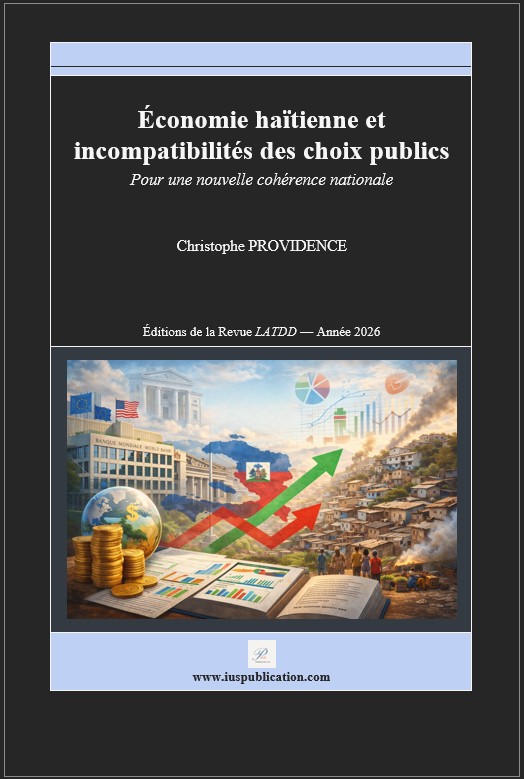
The Haitian Economy and Incompatibilities of Public Choices: Towards a New National Coherence (Academic Book) - Professor Christophe Providence
2026
Haiti has been living for several decades under the sign of economic fragility, international dependence and institutional instability. Successive public policies, whether inspired by donors or dictated by social emergencies, have failed to put the country on a sustainable development path. Why do these blockages persist, despite multiple reforms and considerable resources mobilized?
This book proposes an innovative response by mobilizing the theory of the incompatibilities of public choices, developed by Christophe Providence. Through the analysis of data from the Économie en Graphes booklets (2016–2025), official reports (BRH, MEF, IHSI) and international publications, the author highlights the structural contradictions that run through public action in Haiti: monetary discipline versus financing needs, social emergencies versus productive investment, national priorities versus international conditionalities.
Far from being limited to the observation of the blockages, the book outlines a roadmap for 2030, articulated around three priorities: rebuilding food, energy and educational sovereignty; build macroeconomic compatibilities through the coordination of instruments; and rethink regional integration in a logic of adjusted sovereignty.
At the crossroads of political economy, social sciences and foresight, this book is an indispensable tool for researchers, public decision-makers, civil society actors and the diaspora. It invites us to think of Haiti no longer from its weaknesses, but from its potential for recompositing, by transforming incompatibilities into levers of national coherence.

Haitian cities: governance, urban services and resilience
Vol. 2 No. 1 (2026)
This themed issue of the peer‑reviewed journal LATDD focuses on “Villes haïtiennes : gouvernance, services urbains et résilience”, bringing together territorial planning, public policy, and sustainability perspectives. We welcome empirical and comparative contributions (case studies, fieldwork, spatial/GIS analyses, indicator-based assessments) that clarify governance mechanisms, investment trade‑offs and pathways toward resilient development. Submissions should connect evidence to actionable recommendations for Haiti and the wider Caribbean.
Submission
Image
e-ISSN: 3135-0968
p-ISSN: 3135-095X
