
The Haitian economy and incompatibilities of public choices
Towards a new national coherence
DOI:
https://doi.org/10.66860/latdd.v.i.36Keywords:
monetary stabilization, financing needs, social emergencies, productive investment, national priorities, international conditionalities, Haitian economy, incompatibilities, public choicesAbstract
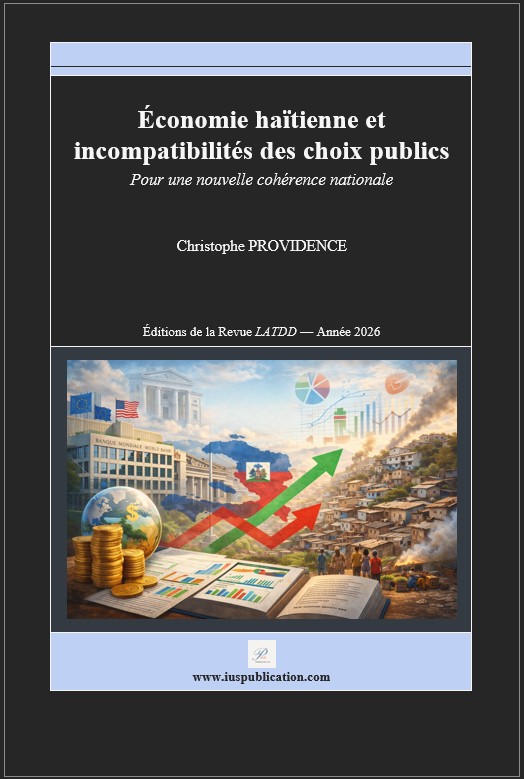
Haiti has been living for several decades under the sign of economic fragility, international dependence and institutional instability. Successive public policies, whether inspired by donors or dictated by social emergencies, have failed to put the country on a sustainable development path. Why do these blockages persist, despite multiple reforms and considerable resources mobilized?
This book proposes an innovative response by mobilizing the theory of the incompatibilities of public choices, developed by Christophe Providence. Through the analysis of data from the Économie en Graphes booklets (2016–2025), official reports (BRH, MEF, IHSI) and international publications, the author highlights the structural contradictions that run through public action in Haiti: monetary discipline versus financing needs, social emergencies versus productive investment, national priorities versus international conditionalities.
Far from being limited to the observation of the blockages, the book outlines a roadmap for 2030, articulated around three priorities: rebuilding food, energy and educational sovereignty; build macroeconomic compatibilities through the coordination of instruments; and rethink regional integration in a logic of adjusted sovereignty.
At the crossroads of political economy, social sciences and foresight, this book is an indispensable tool for researchers, public decision-makers, civil society actors and the diaspora. It invites us to think of Haiti no longer from its weaknesses, but from its potential for recompositing, by transforming incompatibilities into levers of national coherence.
References
Published
Issue
Section
License
Copyright (c) 2026 Journal of Leadership, Planning, Tourism & Sustainable Development (LATDD)

This work is licensed under a Creative Commons Attribution 4.0 International License.
