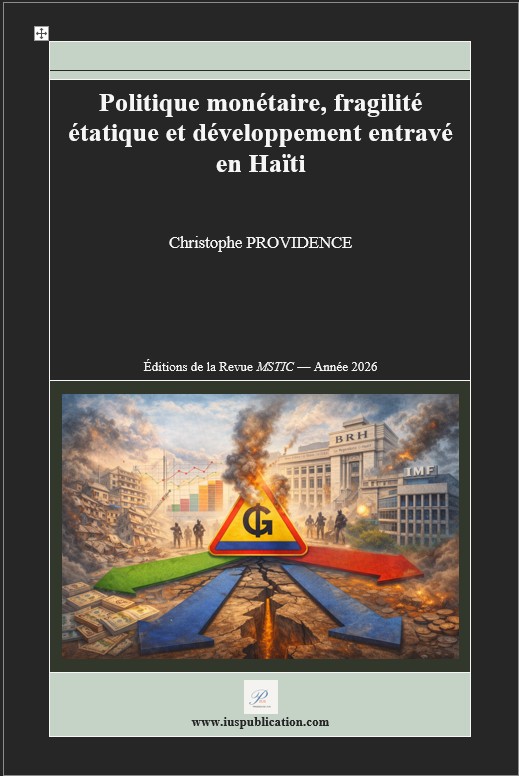
The Economic Theories Mobilized by the BRH
DOI:
https://doi.org/10.66860/mstic.v.i.73Keywords:
monetarism, Keynesianism, IMF, informality, dollarizationAbstract
This chapter analyzes the theoretical frameworks that explicitly or implicitly shape the BRH’s monetary action. It first examines monetarist influence, centered on money-supply control, inflation, and fiscal discipline. It then contrasts this framework with Keynesian approaches, mobilized during crises to justify liquidity support, credit easing, and activity stabilization. The chapter shows that these frameworks, often imported from more stable institutional contexts, collide with Haitian realities: widespread informality, weak transmission channels, dollarization, import dependence, and international conditionalities. The analysis highlights a permanent tension between monetary orthodoxy, the need for recovery, and constraints imposed by the IMF and the World Bank. It concludes that the issue is not to mechanically choose one school of thought, but to adapt theoretical tools to the country’s structural fragility.
References